Overview of Lake Biwa
Size
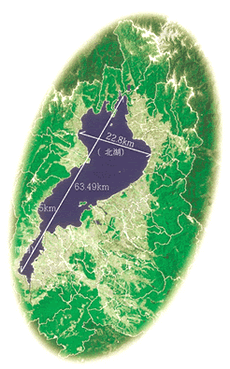
Lake Biwa has a surface area of about 670 square kilometers, making it the largest lake in Japan. However, compared to lakes worldwide, Lake Biwa ranks 129th among freshwater lakes, and 188th when including saltwater lakes, and falls below 200th if dam lakes are also included.The circumference of Lake Biwa is about 235 kilometers. The narrowest part of the lake is spanned by the Biwako Ohashi Bridge, with the area north of the bridge called the North Basin and the area south of it called the South Basin. Water quality and water movement differ between the North and South Basins.
Rivers and Lake Water
Lake Biwa receives water from 117 first-class rivers. Only the Seta River and Biwako Sosui, which are artificial drainage channels created during the Meiji period, serve as outflows at the southern end of the South Basin. Their water is used as domestic and industrial water by approximately 14 million people in the Kyoto-Osaka-Kobe area.Since the enforcement of the Lake Biwa Ordinance in 1980 (officially, the Shiga Prefecture Ordinance for the prevention of Eutrophication of Lake Biwa), Lake Biwa's water quality has improved slightly. However, despite the development of sewerage systems, water quality has largely remained unchanged. The residence time of water in Lake Biwa is about 19 years, so continuous efforts are still necessary to restore and maintain its water quality.
Organisms
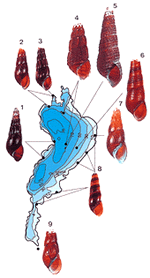 |
Lake Biwa is a tectonic lake, formed as water accumulated in a basin created by tectonic activity. It first appeared about 4 million years ago in the area of present-day Iga City, Mie Prefecture (Paleo-Lake Biwa). Over time, Paleo-Lake Biwa has shifted and evolved along with crustal movements, and it is believed to have reached its current location and depth about 430,000 years ago. In general, lakes tend to disappear within tens of thousands of years due to sedimentation, so lakes with a long history, called ancient lakes, are rare. Lake Biwa is one of only about 20 ancient lakes in the world, along with Lake Baikal, Lake Tanganyika, and the Caspian Sea. Lake Biwa harbors abundant biodiversity, with over 2,300 species, 66 of which have been reported as endemic to the lake as of 2025. In particular, freshwater snails of the genus Semisulcospira include not only species that are widely distributed throughout the lake, but also species restricted to small islands such as Take-Island and Shiraishi. As a result, 19 endemic species of Semisulcospira are found in Lake Biwa, making this the most diverse group in the lake. Lake Biwa is also an important habitat for waterbirds, with more than 100,000 visiting the lake each year to spend the winter. As a result, in 1993, it was designated a Ramsar site under the Convention on Wetlands of International Importance, especially as a waterfowl habitat. |
|
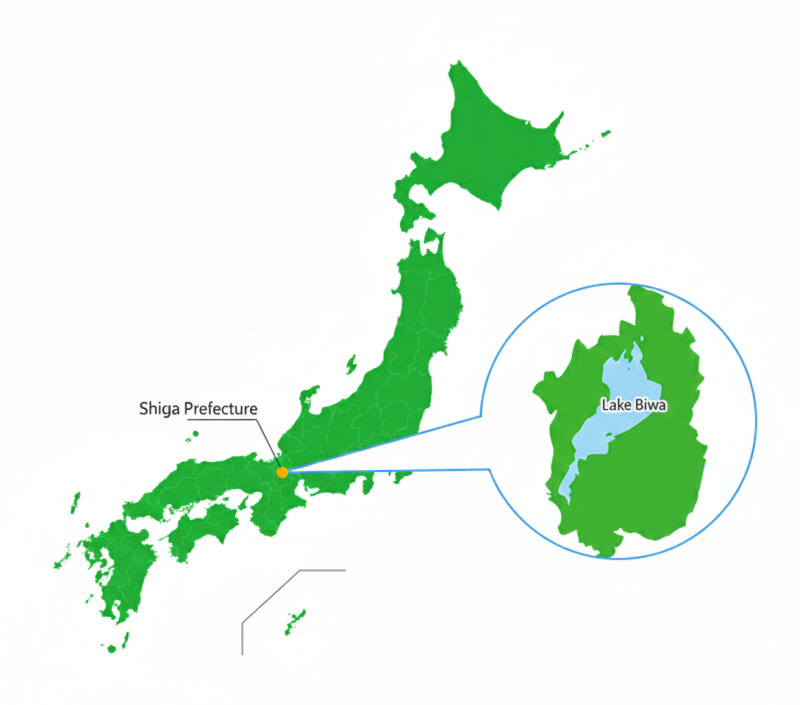
・Area of Shiga Prefecture: …………………… Approximately 4,017km2 |